

By Maya Ellison ·
Dermaplaning: What It Is, How It Works, and What to Expect
Dermaplaning went from a quiet backstage trick to something people ask their facialist about by name. The appeal is easy to understand once you have felt it. Skin that was catching the light in a soft, hazy way suddenly reads smooth, foundation stops clinging to fine hairs, and the whole face looks like it woke up early.
What follows covers the whole picture. What the blade actually removes, how a salon treatment differs from a pass you do yourself on a Sunday evening, what results you can reasonably expect, and the skin situations where the right move is to put the razor down.
What dermaplaning actually is
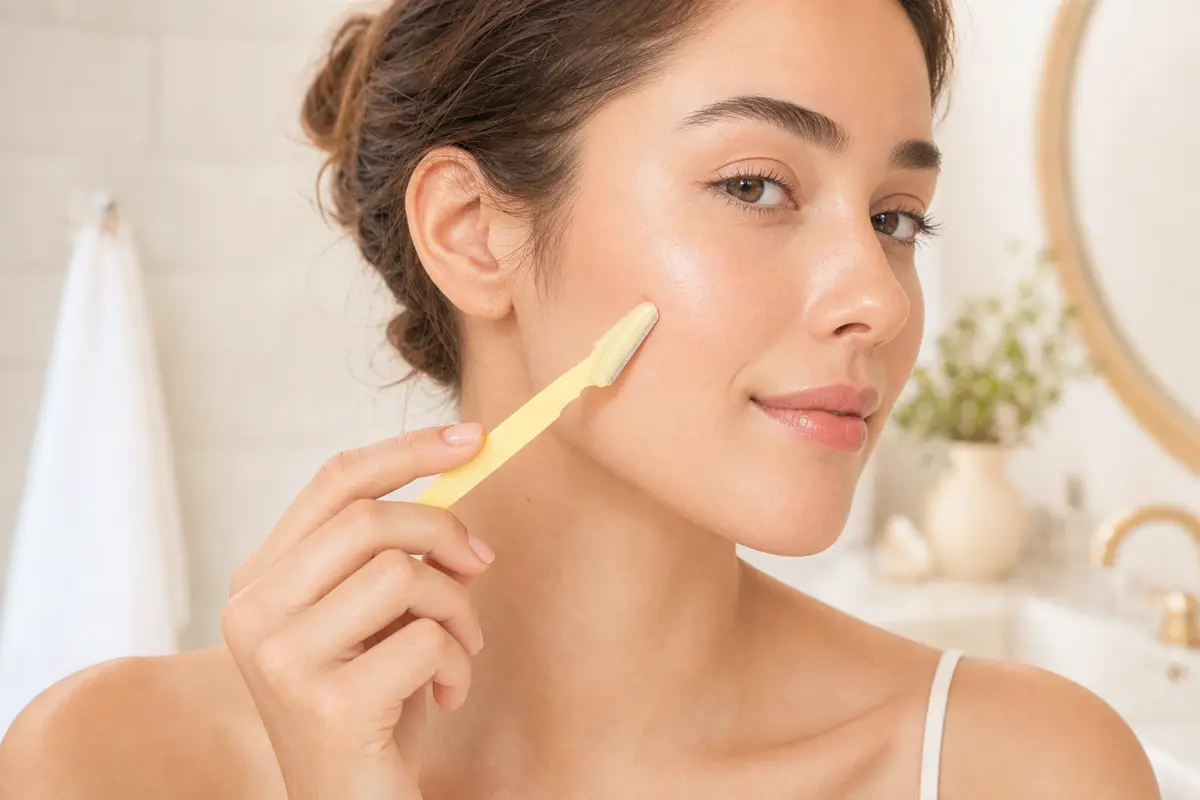
Strip away the marketing and dermaplaning is one simple mechanical action. A sharp, straight edge travels across the surface of the skin at a shallow angle and shaves off what is sitting on top of it. That top layer is a mix of two things: dead corneocytes that have finished their life cycle and have not flaked away yet, and vellus hair, the fine, unpigmented down that covers most of the face.
The word sounds clinical because the technique started in a clinical setting. In a treatment room, an esthetician uses a sterile, unguarded blade and works section by section with one hand stretching the skin flat. The at-home version keeps the physics and changes the tool. A facial razor puts a guard between the edge and your skin, which is precisely why the technique translated so well from the salon to the bathroom counter.
One clarification worth making early, because it causes a lot of confusion in search results. Dermaplaning is a surface exfoliation, and it is entirely cosmetic. It is not a resurfacing procedure, it does not reach the living layers of skin, and it is not a treatment for any skin condition. Everything below is written with that boundary in mind.
What the blade removes
Two things come off, and it helps to picture them separately.
The first is dead surface cells. Skin renews itself continuously, and the finished cells at the top do not always shed cleanly. They pile up, scatter light unevenly, and give the face that slightly dull, grainy quality that no amount of highlighter fixes. Lifting them is what makes the immediate difference you feel with your fingertips.
The second is vellus hair. This is not the coarse hair of the brow or the upper lip on some faces, it is the fine down that runs along the cheeks, the jaw and the sides of the forehead. It is usually invisible until light hits it sideways, and then it reads as a soft halo. It also holds onto product. Foundation catches on it, powder settles into it, and sunscreen can look patchy across it.
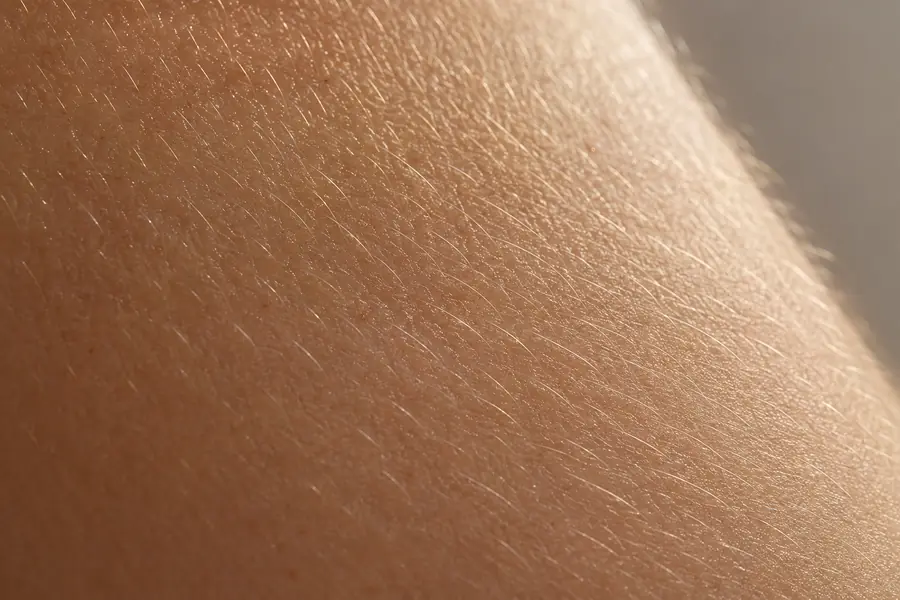
Notice what is not on that list. Dermaplaning does not remove the hair root, so nothing about it is permanent. It does not treat pigmentation, scarring or texture that sits below the surface. And it has no effect on the follicle itself, which is the whole reason the thicker-regrowth myth falls apart. We take that myth apart in more detail in dermaplane vs. shaving.
In a treatment room vs. at home
This is the fork in the road for most people reading about dermaplaning, and the two versions serve different jobs. A professional treatment is a scheduled appointment with a trained pair of hands and an unguarded blade. An at-home pass is a five-minute habit you fold into a routine you already have.
| What differs | In a treatment room | At home |
|---|---|---|
| Tool | Sterile surgical blade, no guard | Facial razor with a built-in safety guard |
| Who holds it | A licensed esthetician | You, in front of a mirror |
| Depth of the pass | More thorough, because the edge is exposed | Lighter, because the guard limits contact |
| Setting | Salon, med spa or clinic | Your bathroom, whenever it suits you |
| Add-ons | Often paired with a facial or a mask | Your own moisturizer and SPF |
| Typical rhythm | Booked every few weeks | Every one to two weeks |
| What it costs you | A per-session price and a slot in your calendar | One reusable razor and five minutes |
Both are valid. A professional pass is more thorough, and if your skin is reactive or you simply want someone else to make the decisions, that is a good reason to book one. What the at-home version offers is rhythm. Peach fuzz and dull surface cells do not wait for an appointment, and a tool that lives in your drawer gets used the week you actually need it.
The tool itself is unglamorous, which is part of the charm. A guarded dermaplane razor is a small stainless blade behind a comb-like guard on a light handle. It comes in multipacks because the edge dulls with use, and swapping to a fresh one is the single easiest way to keep a pass comfortable. If you want the criteria that separate a good one from a frustrating one, we lay them out in the best dermaplane razor guide.
What it does for your skin
The results people actually report cluster into three areas, and all three are surface-level by design.
Smoother texture comes first and arrives immediately. Run a hand along your jaw before and after and the difference is obvious. That instant feedback is a large part of why the habit sticks.
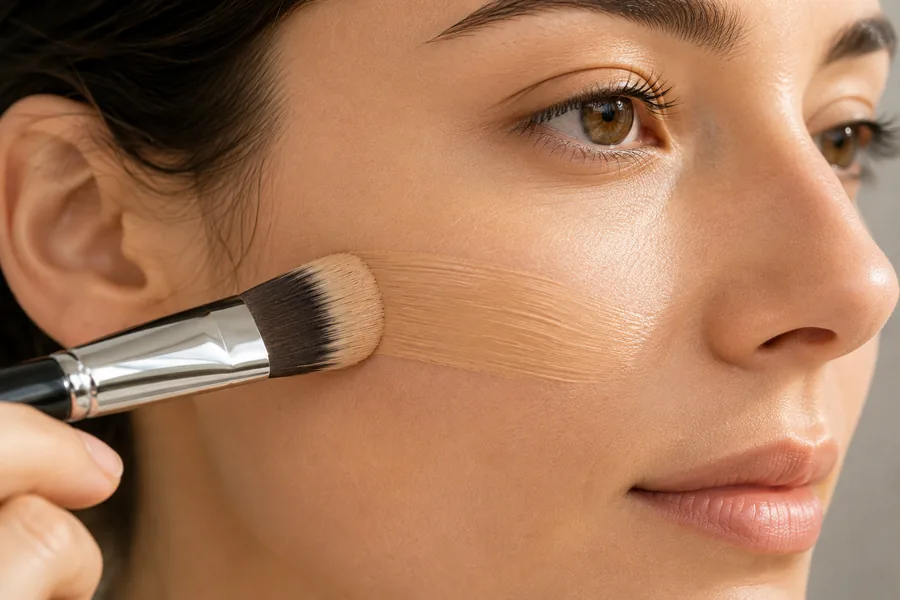
Better makeup application is the benefit most people fall in love with. Foundation is formulated to sit on skin, not on fuzz, so removing the down gives it a flat surface to spread across. Coverage looks more even, powder stops gathering in fine hairs, and the whole base tends to sit closer to the skin.
Skincare absorption is the third. With the layer of dead cells cleared, serums and moisturizers meet skin rather than debris. Expect a difference in how products feel and spread rather than a transformation, and give the same courtesy to the products themselves: a freshly exfoliated face is more receptive to strong actives, which is a reason to keep them for another day. There is a fuller breakdown in dermaplaning benefits.
It is worth being clear about the ceiling. Dermaplaning works on what sits on the surface, so it does not change pores, pigmentation, scarring or the structure of your skin. Anyone promising more than a smoother surface is selling you something other than dermaplaning.
What an at-home session looks like
Start with a clean face, patted completely dry. This is the rule people break most often, and it matters because dermaplaning is a dry technique. A damp surface makes the blade drag and skip, and dragging is where nicks come from. Skip oils and heavy creams beforehand, and give yourself decent light and a mirror you are not squinting into.
Hold the razor at roughly a forty-five degree angle to the skin. Too flat and the edge slides over the hair without catching it. Too steep and you are scraping rather than skimming. With your free hand, pull the skin taut in whichever section you are working on, because a flat surface is what lets the blade travel cleanly.
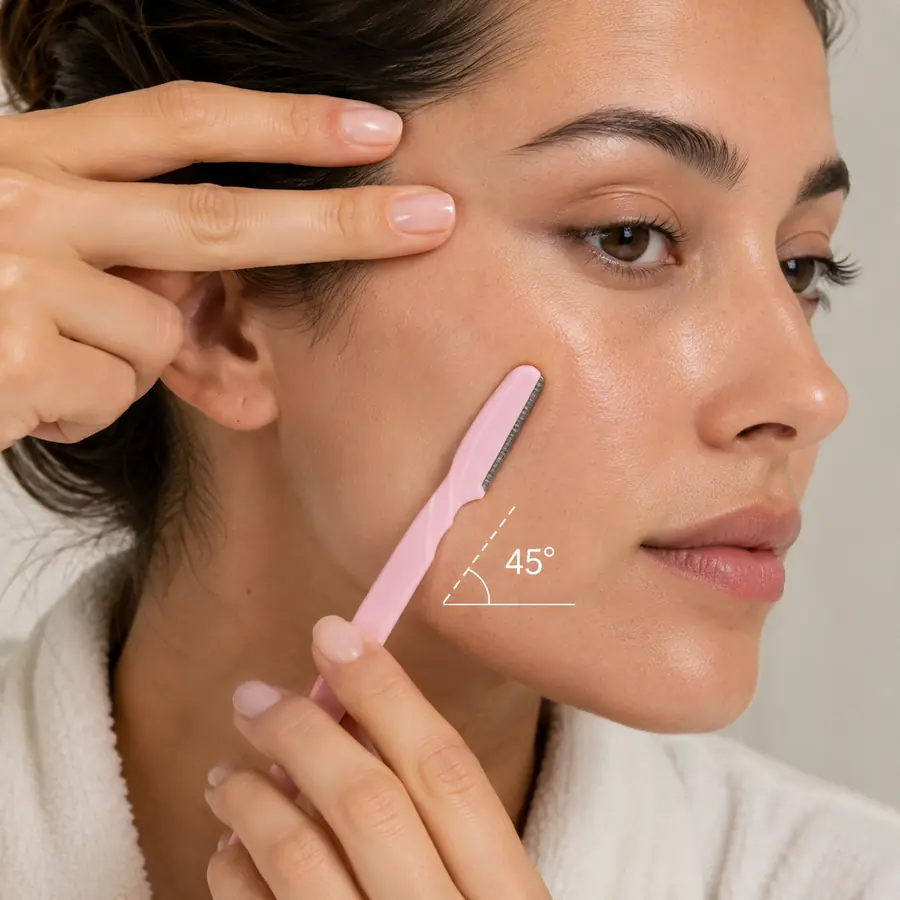
Work in short strokes, roughly one to two inches, moving downward with the direction the hair grows. Wipe the blade on a tissue between strokes so nothing smears back onto your face. Cheeks and jawline are the easiest place to begin, since they are broad and flat. Leave the upper lip and the sides of the nose until the motion feels automatic, and stay off the eyelids entirely. The full routine, zone by zone, lives in how to dermaplane at home, and if you are holding the tool for the first time, how to use a dermaplane razor covers the grip.
A word on brows, since it is the question that always comes next. The same blade tidies stray hairs and cleans up the line under the arch, but it wants tiny, deliberate strokes rather than the long ones you use on a cheek. That precision work is its own small skill, covered on the eyebrow razor page. If you would rather let a motor set the pace, the electric dermaplane tool does comparable surface work with a powered head.
Who it suits, and who should skip it
Dermaplaning suits most healthy, calm skin, and it is genuinely a good fit for anyone whose main complaint is dullness, visible fuzz or makeup that will not sit flat. It is also popular with people who cannot use grainy scrubs comfortably, since there is no rubbing involved.
There are real situations where the answer is no, or not today. This table is the one to read twice.
| Skin situation | What to do instead |
|---|---|
| Active breakouts or inflamed spots | Wait for the skin to calm, or pass only over clear zones |
| Rosacea in a flare | Let the flare settle completely before any exfoliation |
| Eczema or psoriasis on the face | Leave the area alone and ask a professional |
| Sunburn, windburn or peeling skin | Give the barrier time to recover first |
| Raised moles, skin tags or warts | Never pass a blade over them, work around them |
| Recent peel, laser or cosmetic treatment | Follow the timeline your provider gave you |
| Very reactive or newly sensitized skin | Patch test one small area and wait a day |
Two more groups belong in this conversation. If you are pregnant or taking medication that thins or sensitizes skin, your skin may behave differently than it usually does, so a quick word with your doctor is the sensible first step. And for anything that looks like a skin health question rather than a grooming one, a dermatologist is the right person to ask. I write about facial razors, and that line is where my expertise stops. The longer version of this section is in is dermaplaning safe.
How often people dermaplane
Once a week to once every two weeks covers most people. That spacing lets the skin renew between passes and keeps fuzz from becoming noticeable again, without asking the surface to recover from constant exfoliation.
Skin type shifts the interval. Oily skin often tolerates the shorter end of that range comfortably. Dry or reactive skin usually prefers every two to three weeks, sometimes longer in winter. The signals to slow down are consistent and easy to read: tightness, flaking, stinging when you apply your usual moisturizer, or redness that lingers past the first hour. When any of those appear, stretch the gap rather than pushing through. We break it down skin type by skin type in how often should you dermaplane.
Blade life follows a separate clock from session frequency. An edge that has stopped feeling sharp is the most common cause of both irritation and nicks, and pushing a dull razor through one more pass is a false economy. How many times can you use a dermaplane razor covers the signals that mean it is time to switch.
Aftercare that protects the result
Aftercare is not an optional appendix to dermaplaning, it is half of the technique. You have just cleared the top layer of dead cells, so the skin underneath is fresher, more receptive and a little more exposed.
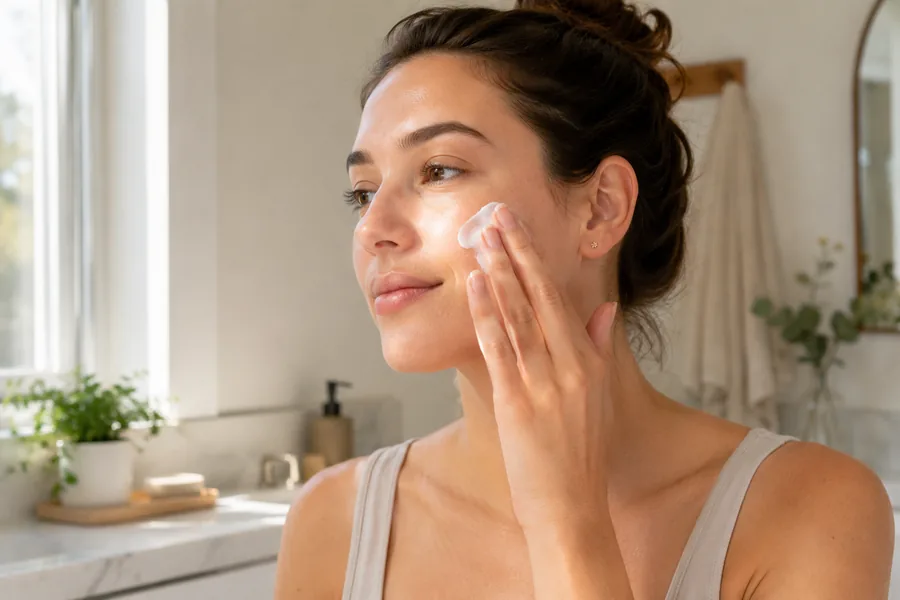
Two steps carry most of the weight. Apply a gentle, fragrance-free moisturizer while the skin is still bare, and follow with a broad-spectrum sunscreen if there is any daylight in your near future. Freshly exfoliated skin is more sensitive to sun, and treating SPF as part of the routine rather than an afterthought is what keeps a good result from turning into an irritated one.
Hold off for the rest of the day on retinol, exfoliating acids, strong vitamin C and anything heavily fragranced. They can sting on a just-exfoliated surface even when they normally sit fine. Mild redness immediately after a pass is common and usually settles within the hour. If it does not, treat that as information: shorten the next session, lighten the pressure, or start with a fresh blade.
Take care of the razor too. Rinse it, dry it, store it somewhere clean and dry, and keep it to yourself. A facial razor is a personal item in the same way a toothbrush is.
Dermaplaning vs. other exfoliation
Dermaplaning is often shopped against treatments that do a related but different job. The clearest way to tell them apart is to ask what happens to the peach fuzz, since that is where the methods genuinely diverge.
| Method | How it works | Effect on peach fuzz |
|---|---|---|
| Dermaplaning | A fine blade skims dead cells and hair off the surface | Removes it |
| Shaving with a body razor | A multi-blade head, water and cream, built for larger areas | Removes it, with less control on facial contours |
| Microdermabrasion | An abrasive tip or fine crystals buff the surface | Leaves it in place |
| Chemical exfoliation (AHA, BHA) | Acids loosen the bonds holding dead cells together | Leaves it in place |
| Physical scrubs | Granules are rubbed across the skin by hand | Leaves it in place |
That single column explains why dermaplaning holds a place that acids and scrubs cannot fill. If your complaint is fine down catching the light and grabbing foundation, only a blade addresses it directly. If your complaint is congestion or uneven tone, a different method is the better tool, and there is no reason the two cannot alternate in the same month with a few days between them.
Against a body razor, the differences are geometry and control. A facial razor is short, single-edged and guarded, which lets it follow the curve of a jaw or the dip above the lip in the small strokes that area needs. That control is also why the same tool ends up in so many routines as a facial razor for women rather than a single-purpose gadget.
Frequently asked questions
What is dermaplaning?
Dermaplaning is a physical exfoliation. A fine blade is drawn across clean, dry skin at a shallow angle to lift dead surface cells and vellus hair, the soft down commonly called peach fuzz. It works at the very top of the skin and leaves the texture smoother right away.
Does dermaplaning make hair grow back thicker or darker?
No. Cutting a hair at the surface does not change the follicle underneath, so it comes back at the same thickness and color. Regrowth can feel blunt for a day or two because the tip was cut straight across instead of tapering, and that texture is what people mistake for thicker hair.
How long do the results last?
The smoothness usually holds for about one to three weeks. Dead surface cells build back up as skin renews itself, and vellus hair regrows at its own pace, which differs from person to person. Most people notice the makeup benefit fading first, which is often the cue to book or plan the next pass.
Is dermaplaning safe to do at home?
For healthy, calm skin, an at-home pass with a guarded facial razor is generally low risk. Use a clean blade on dry skin, keep the pressure light, and stay away from active breakouts, raised moles and irritated areas. Anyone with a diagnosed skin condition should check with a professional first.
Does dermaplaning hurt?
It should not. Most people describe the feeling as a light scraping or a soft brushing sound near the ear. Sharp sensation is a signal, not part of the process, and it usually means the pressure is too heavy, the blade is dull, or the skin is damp rather than dry.
Can you dermaplane over acne?
No. A blade passing over inflamed spots can irritate them and move bacteria across the face. Work around clear zones instead, or wait until the skin is calm. Dermaplaning is a cosmetic exfoliation and it is never a way to manage a breakout.
How is dermaplaning different from microdermabrasion?
Both exfoliate the surface, but they use different mechanics. Dermaplaning slices dead cells and fine hair away with a blade. Microdermabrasion buffs the surface with an abrasive tip or fine crystals, so it smooths texture without removing peach fuzz.
Dermaplaning earns its reputation honestly. It does one small mechanical thing well, the payoff is visible the same evening, and the whole technique fits into five minutes once the angle clicks. Keep the blade clean, the skin dry, the pressure light and the sunscreen on, and it becomes the quiet step that makes the rest of your routine look better. If you want to keep reading, the whole library sits in the Peachly guides, and what people say after living with the tool is on the reviews page.
Maya Ellison · Beauty writer & at-home dermaplaning enthusiast
Maya writes practical, honest at-home skincare guides. She is not a dermatologist, so for any medical skin concern she points readers to a professional.