

By Maya Ellison ·
How Many Times Can You Use a Dermaplane Razor?
This is the question I am asked most, and it has the least satisfying answer: nobody can hand you a number. Not me, not a label, not a dermatologist. What I can hand you is better, because it works on the razor in your hand rather than on an average one somewhere.
So this guide is about one thing only, the life of a single blade. It is not about how often to dermaplane your face, which is a different question with a different answer. Almost everyone runs the two together, so I have given the distinction its own section below.
Why nobody can give you a number
A blade does not wear on a schedule, it wears on what you ask of it. How much surface you cover in a session. How dense your peach fuzz is, which is your own hair and not a standard. How much dead surface skin the edge has to lift. How much pressure your hand naturally applies. And, more than most people expect, what happens to the razor between sessions. Two people can open the same multipack on the same morning and be on completely different timelines by the end of the month.
You will not find a number of uses published anywhere on this site, and that is deliberate. A count is easy to write and easy to trust, and that is the problem: you would follow the number instead of the blade. If a razor still glides cleanly, there is no reason to bin it. The steel tells you, every session.
The signals that a blade is finished
Here is the useful part. A spent blade announces itself, and once you know what you are feeling for you will not wonder again. These are the signals, in the order most people notice them.
| Signal | What it feels like | What to do |
|---|---|---|
| It tugs instead of gliding | The edge grabs the fine hair and pulls before cutting | Stop and switch razors |
| It catches and stutters | Stop-start rhythm rather than one smooth stroke | Switch razors |
| One pass is no longer enough | You go back over the same patch for the old result | Switch rather than repeat |
| The sound changes | The soft, even scrape turns rough and uneven | Finish gently, then retire it |
| Nicks where they never happened | Small catches on skin that used to be easy | Retire it immediately |
| Anything visible on the steel | Discoloration, spotting or a rough patch on the edge | Retire it, do not rinse and reuse |
The third row deserves a warning of its own, because it is the signal people push through rather than act on. Going over the same patch twice is already listed as a mistake in how to use a dermaplane razor, and a fading blade is what quietly pushes you into it. If you have started double-passing to get the finish you used to get in one, your technique has not slipped. The edge has.
The last row is the only signal that is not about feel, and the one where I would give a razor no benefit of the doubt: if you can see anything on the steel that was not there when you opened the packet, it has no business near your face. Verified buyer Morgan A. described the feeling you want back every session: "Good product... cuts well".
Why a dull blade irritates more
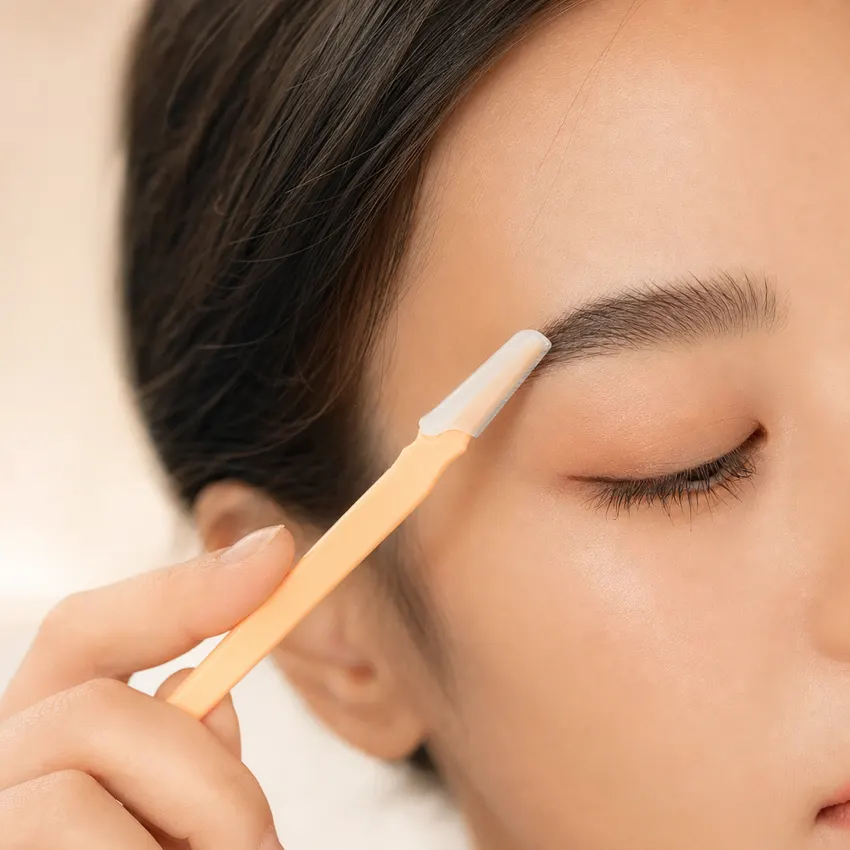
This sounds backwards until you think it through. A sharp facial blade does its work with the edge and almost no downward force. You hold it at a shallow angle, you glide, and the fine vellus hair and dead surface cells come away with barely any pressure reaching the skin underneath.
When that edge loses its bite, the hair resists instead of parting, and a hand compensates the only way a hand knows how: by pressing harder and going over the spot again. Both are exactly what turns a surface pass into contact with living skin. Pressure drives the guard and the blade down into the layer you are meant to skim over, and repeat passes strip the same patch twice in one sitting.
So the tool that feels like it is doing less is often the one doing more harm, and that matters more here than on a leg, because skin you have just exfoliated is more exposed by definition. That is covered properly in is dermaplaning safe. Redness that outlasts the first hour, stinging from a moisturizer that never stung before, a nick in a spot that never nicks: all of it gets blamed on skin or on technique, when the culprit is often an edge that stopped working two sessions ago.
A fresh razor fixes a blade problem, and a blade problem is what most of this is. If irritation is still there after you have changed razors, it was never the steel. That is a skin question, and a dermatologist is the right person to answer it rather than an article. I write about facial razors and hold no dermatological credential.
Drying, the habit that protects the edge
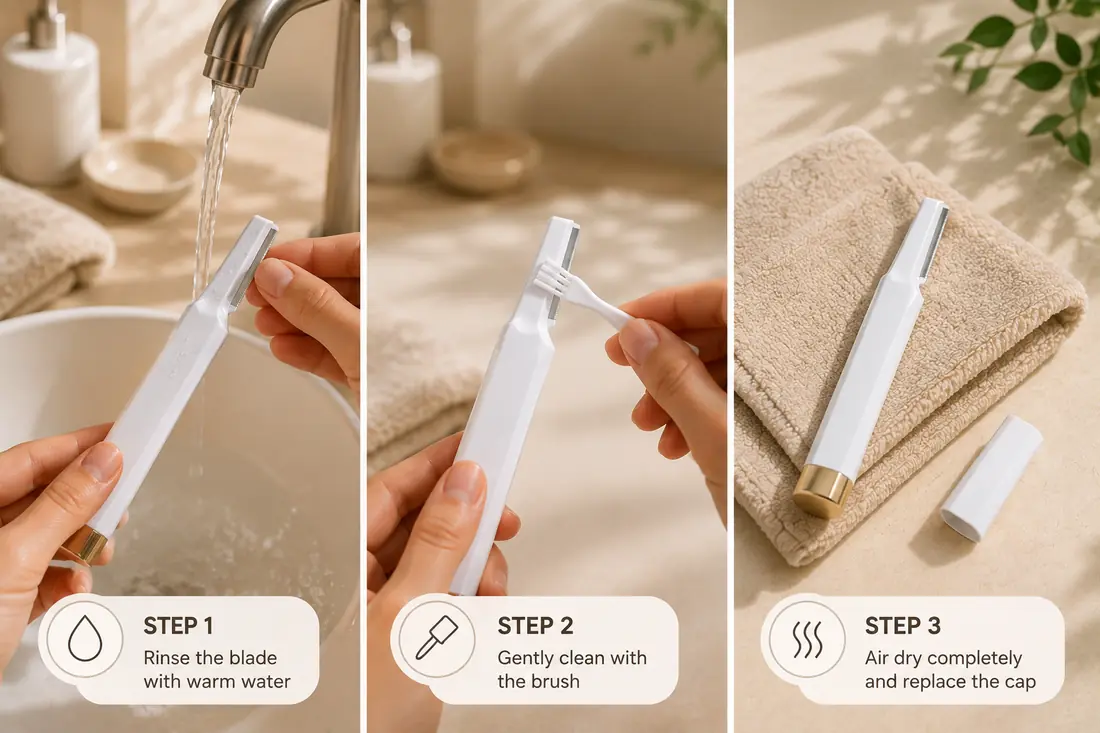
If there is one lever you genuinely control, it is what happens in the minute after you finish. Rinse the blade under warm water to clear the hair and dead skin off the edge, then let it dry completely before you cap it or put it away. That second half is the step almost everyone skips, and it is the one that counts.
Storing a wet blade is the fastest way to dull it. Water sitting against a fine steel edge takes the crispness off it, and it is what lets rust marks form on a razor that was perfectly good the day before. A razor left on the edge of a sink, or capped while still damp and dropped in a drawer, is being aged on purpose without anyone meaning to.
Where you keep it matters as much as whether you dried it. A cabinet that gets a hot shower run past it twice a day is a humid box, and a razor stored there is never really dry. Keep it away from steam, and put the guard back on for travel.

Why a facial razor is never shared
This section has no signals and no gray zone, so I will keep it short and firm. A facial razor is a single-person item, in the same category as a toothbrush. Not shared between friends, not between partners, not between a mother and a daughter.
The reason is simple. A blade lifts dead cells and at times makes contact with tiny amounts of blood you never see or feel. Anything the edge picks up goes onto the next face it touches, and that face has just been exfoliated, which is precisely when you would least want it. No rinse makes a shared blade a good idea.
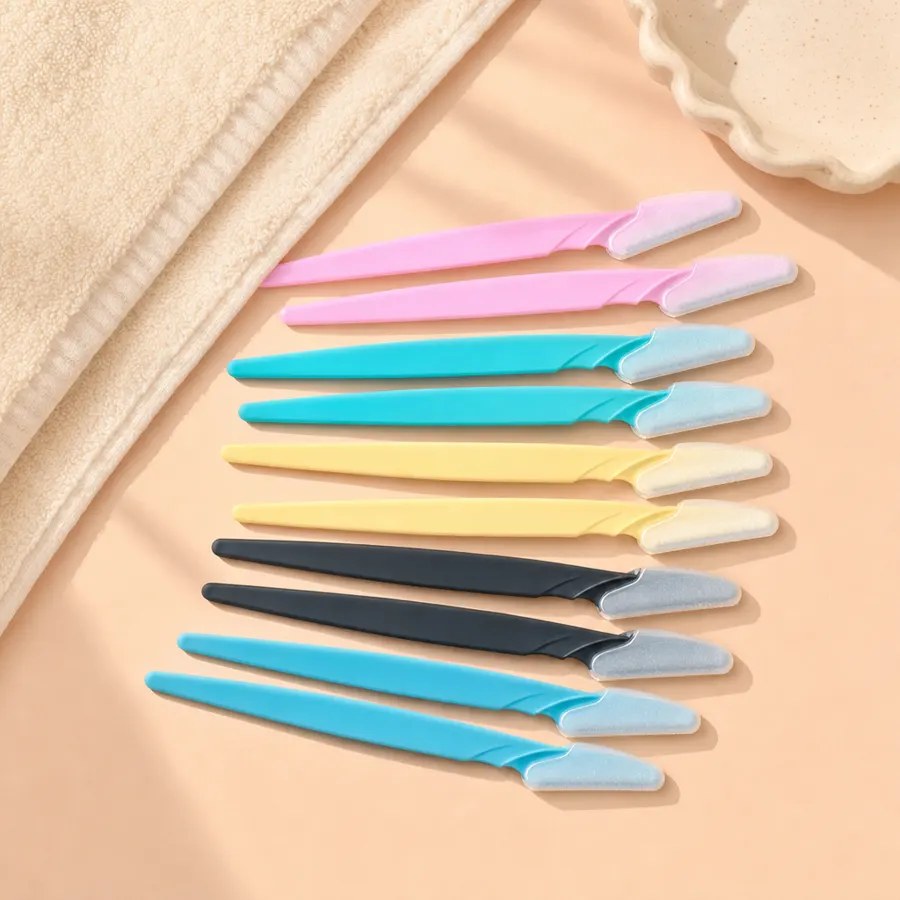
Sharing out razors from a pack is a completely different thing from sharing a razor, and it is why a multipack suits a household. Everyone gets their own, and the assorted colors make it obvious whose is whose.
Blade life is not frequency
Two questions get asked in the same breath and have almost nothing in common. "How often should I be doing this?" is about your skin and how long it needs to settle between passes. "How long does this razor last?" is about steel and how fast an edge wears.
| Question | What sets the answer | Where the answer is |
|---|---|---|
| How often should I dermaplane? | Your skin type and how it feels the next morning | How often should you dermaplane |
| How long does this razor last? | Wear on the edge, and how it was dried and stored | This page |
They interact in one direction only. A tighter interval wears an edge faster, so someone dermaplaning weekly rotates to a fresh razor sooner than someone going every third week. It does not run backwards: a drawer full of unopened razors is never a reason to pick up the pace. Your skin sets the calendar; the blade only decides which razor you reach for on the day.
Rotating through a multipack
Once you stop counting passes, the system is easy. Open one razor, use it until it gives you a signal from the table above, retire it, open the next. The assorted colors do the bookkeeping for you, because the one in use is a color you remember and the sealed ones stay obviously sealed.
Keeping one razor aside purely for brows is the refinement most people land on. Brow strays get tidied far more often than a full face gets a pass, but the surface is tiny, so a razor used as an eyebrow razor and one used as an everyday facial razor for women wear at completely different rates. Split them and neither is judged by the other's schedule.
When a razor is done, dispose of it with the guard on or wrapped, not loose in a bin where a hand can catch it. Verified buyer Rachel E. left this: "Does as described. second purchase now. luv".
Assorted shades in every multipack, so the razor in use is easy to tell from the sealed ones
— Peachly product spec, 2026
Average rating left by verified buyers of the manual razors
— Peachly verified reviews, 2026
Money-back window on every order, so you can judge how a blade feels on your own skin
— Peachly returns policy, 2026
The short version: judge the blade, not the count. It works while it glides, and it is finished the moment it tugs, catches, needs a second pass, sounds rough or shows anything on the steel. To compare the options, read the best dermaplane razor guide and see what buyers report on the reviews page. The reusable multipacks are on the dermaplane razor page.
Blade life questions, answered
Can I sharpen a dermaplane razor?
No. These are fine facial blades, not kitchen knives, and nothing you can do at home restores that kind of edge. Filing or stropping one leaves a rough edge that drags worse than the dull one you started with. Retire it and open a fresh razor instead.
Is a dull blade actually risky, or just annoying?
Annoying first, then a problem. A blunt edge makes you press harder and go over the same patch twice, and pressure plus repeat passes is what causes nicks and lasting redness. On freshly exfoliated skin that matters more than it would elsewhere on the body.
Would using it on damp skin make a blade last longer?
No, and it works against you twice. Dermaplaning is done on clean, dry skin because that is what lets the blade skim the surface properly, and moisture left on the steel between sessions is one of the things that dulls it. Wet skin costs you the pass and the blade.
How should I store the razors I have not opened yet?
Somewhere dry and away from shower steam, with the guard on. An unopened razor in a humid bathroom cabinet meets the same damp air as one you have already used, so a drawer outside the bathroom is the safer home for a multipack.
Maya Ellison · Beauty writer & at-home dermaplaning enthusiast
Maya writes practical, honest at-home skincare guides. She is not a dermatologist, so for any medical skin concern she points readers to a professional.